What to Do If You Witness Animal Abuse in Crete
Holidays in Crete are usually all sunshine and good food — but now and then you may come across an animal in trouble, or witness something that clearly isn’t right. It’s a horrible feeling, and it’s easy to assume there’s nothing a visitor can do. There is. A calm, factual report to the right authority genuinely helps, and you don’t need to speak Greek or live here to make one.
Here’s who to contact and how to report effectively.
First, check whether it’s abuse
Greece’s animal welfare law is Law 4830/2021. It’s worth a quick look to confirm that what you saw actually counts as abuse or a welfare violation, so you can act accordingly. You can read it here: Greek version · English version.
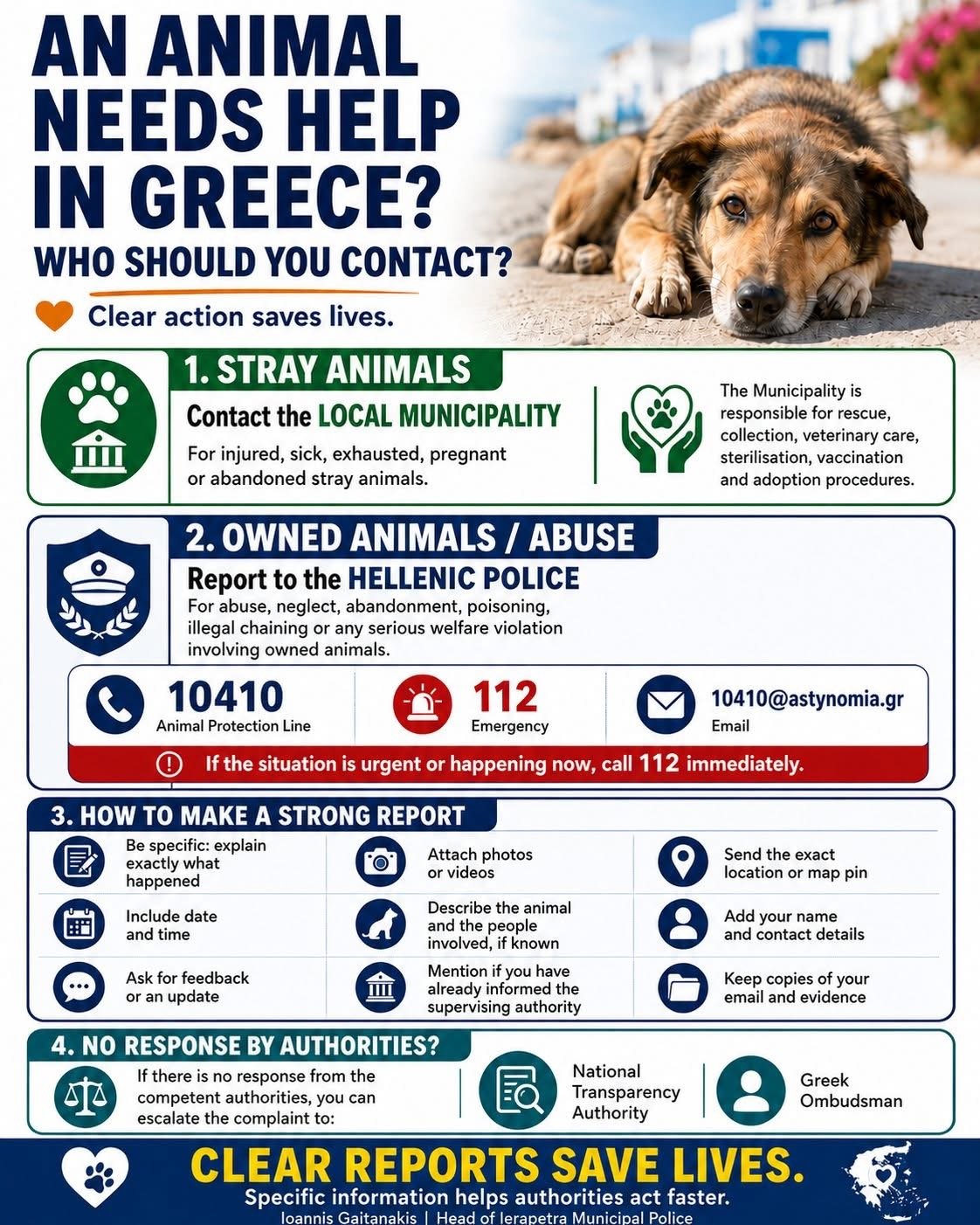
Stray animals: contact the local municipality
For a stray animal that is injured, sick, exhausted, pregnant or abandoned, the responsible body is the local Municipality (Dimos). Municipalities are legally responsible for the rescue, collection, veterinary care, sterilisation, vaccination and adoption of strays.
Ask your accommodation or a local for the number of the municipality you’re staying in, and explain what you’ve found and exactly where it is.
Owned animals & abuse: report to the Hellenic Police
For abuse, neglect, abandonment, poisoning, illegal chaining, or any serious welfare violation — especially involving an owned animal — report to the Hellenic Police. For the past couple of years there’s been a dedicated four-digit line just for animal abuse:
☎️ 10410 — Animal Protection Line ✉️ 10410@astynomia.gr — report in writing 🚨 112 — if it’s urgent or happening right now, call this immediately
You can report by phone or in writing — but a written report is recommended, because it gives you a record you can follow up on as the case progresses. Doing both (call and email) is even better.
How to make a strong report
The single most important thing: stick to the facts. Describe only what you actually observed, without emotional language — it’s what helps the authorities act. A strong report includes:
- Be specific — explain exactly what happened
- Date and time of what you saw
- Photos or videos, if you have them
- The exact location or a map pin
- A description of the animal and of the people involved, if known
- Your name and contact details
- Whether you’ve already informed the supervising authority
- A request for feedback or an update on the case
- Keep copies of your email and any evidence
CC an animal-welfare organisation
When you email your report, it’s a good idea to CC an animal-welfare organisation or two, so more people are watching how the case develops. Two national bodies:
- Panhellenic Environmental and Animal Welfare Society — info@pfpo.gr
- Panhellenic Federation “Nemesis” — info@nemesisfederation.gr
There are also active local groups across Crete who know the area and can help follow a case:
- Chania — Animal Welfare Society of Chania: chaniapets@yahoo.gr, info@animalscare.gr · Facebook
- Rethymno — “Noiazomai” Rethymno Animal Welfare Volunteers: niazomai@gmail.com · Facebook
- Heraklion — “Seirios” Heraklion Animal Welfare Society: fo.seirios@gmail.com, fo.seirios@yahoo.gr · Facebook group (large membership covering the whole island)
- Agios Nikolaos — Facebook group
- Sitia — Facebook group
If the authorities don’t respond
If the competent authorities don’t act, you can escalate the complaint to:
- the National Transparency Authority
- the Greek Ombudsman
Save this poster
The clear guide below was created by Ioannis Gaitanakis, Head of Ierapetra Municipal Police, who has done important work on animal welfare in Crete. It’s worth saving on your phone before you travel — clear reports really do save lives.